The Breathing Membrane: Hanji and the Sculpting of Light
23 March 2026
Hanji transcends its origins as traditional Korean mulberry paper to become a profound philosophical medium. By capturing and sculpting light, this breathing membrane embodies the quiet luxury of impermanence and organic resilience.
In the quiet, exalted lexicon of traditional Korean craft, if aged wood constitutes the bone and cured lacquer forms the skin, then Hanji—the ancient, hand-beaten mulberry paper—is the undeniable breath. For centuries, Hanji served as the literal and metaphorical membrane between the harsh, unpredictable exterior world and the serene, cultivated interior of the traditional hanok. Stretched taut over intricately joined wooden lattice doors, it never sought to aggressively block the sun; rather, it negotiated with the elements. It diffused the harsh, blinding glare of midday into a soft, ambient, and enveloping glow that shifted in real-time with the passing clouds and the arc of the sun. Today, a new vanguard of purists and contemporary artisans is reclaiming this ancient material, stripping it of its purely functional, historical baggage, and elevating it into a profoundly abstract medium for sculpting light itself. This movement is not merely an exercise in papercraft or nostalgic revivalism; it is a rigorous, avant-garde exploration of translucency, fragility, and the invisible, kinetic currents of air that surround us. It is the birth of a new brutalist luxury, where the raw, unrefined truth of a material is prized above all artificial gloss.
To understand Hanji is to understand the philosophical doctrine of interstitial spaces—the profound space between states of being. In the context of Eastern philosophy, particularly the fluid dynamics of Yin and Yang, Hanji represents the ultimate harmonization of opposing forces. It is the threshold where the brutal cold of winter meets the hearth’s warmth, where the blinding light of the cosmos is distilled into the intimate shadows of human habitation. Unlike glass, which creates a hard, impermeable barrier that separates humanity from nature, Hanji is a porous, breathing interface. It invites the outside world in, but only after softening its edges. This philosophical tenet of mediation speaks to a deeper cultural reverence for harmony over dominance. In an era defined by stark binaries and absolute boundaries, the Hanji membrane offers a radical alternative: a material that exists in a state of constant, empathetic negotiation with its environment.
The creation of Hanji is an act of profound, almost punishing botanical alchemy, rooted in the rhythms of the earth and the grueling labor of the human hand. The process begins in the bitter cold of winter, when the inner bark of the dak (paper mulberry tree) is harvested. This timing is crucial, as the cold prevents the fibers from degrading, ensuring maximum tensile strength. The bark is then boiled in a highly alkaline lye derived from the ash of burned buckwheat stalks, a process that strips away impurities while leaving the core cellulose intact. Following this, the fibers are subjected to dochim, a rhythmic, percussive beating on a stone anvil that flattens and aligns the cellular structure, imparting an extraordinary density. The beaten pulp is meticulously suspended in a vat of icy water mixed with dakpul, a viscous mucilage extracted from hibiscus roots. This natural dispersant prevents the long fibers from clumping, allowing them to float in a milky, chaotic suspension. The master papermaker then uses a fine bamboo screen to scoop the mixture, swaying it rhythmically—forward, backward, left, and right—in a technique known as oebal-tteugi. This multidirectional agitation forces the long mulberry strands to cross and interlock in a dense, randomized web.
This complex, interlocking architecture creates a material of astonishing, paradoxical resilience. Hanji is a fabric of contradictions: a material so structurally sound it was historically oiled and layered to craft lightweight armor capable of repelling arrows, yet so porous and delicate it is universally described as a material that 'breathes.' Unlike Western paper, which is historically manufactured from short cotton or wood pulp fibers and heavily sized to create a passive, opaque, and dead surface for the application of ink, Hanji is an active, kinetic participant in its spatial environment. It is alive. It expands with the heavy humidity of summer and contracts in the brittle cold of winter. It responds to the ambient conditions of a room, acting as a natural regulator of moisture and air. Most importantly, it interacts with light in a way that feels distinctly biological, possessing a brutalist elegance that refuses to hide the scars and textures of its own making.
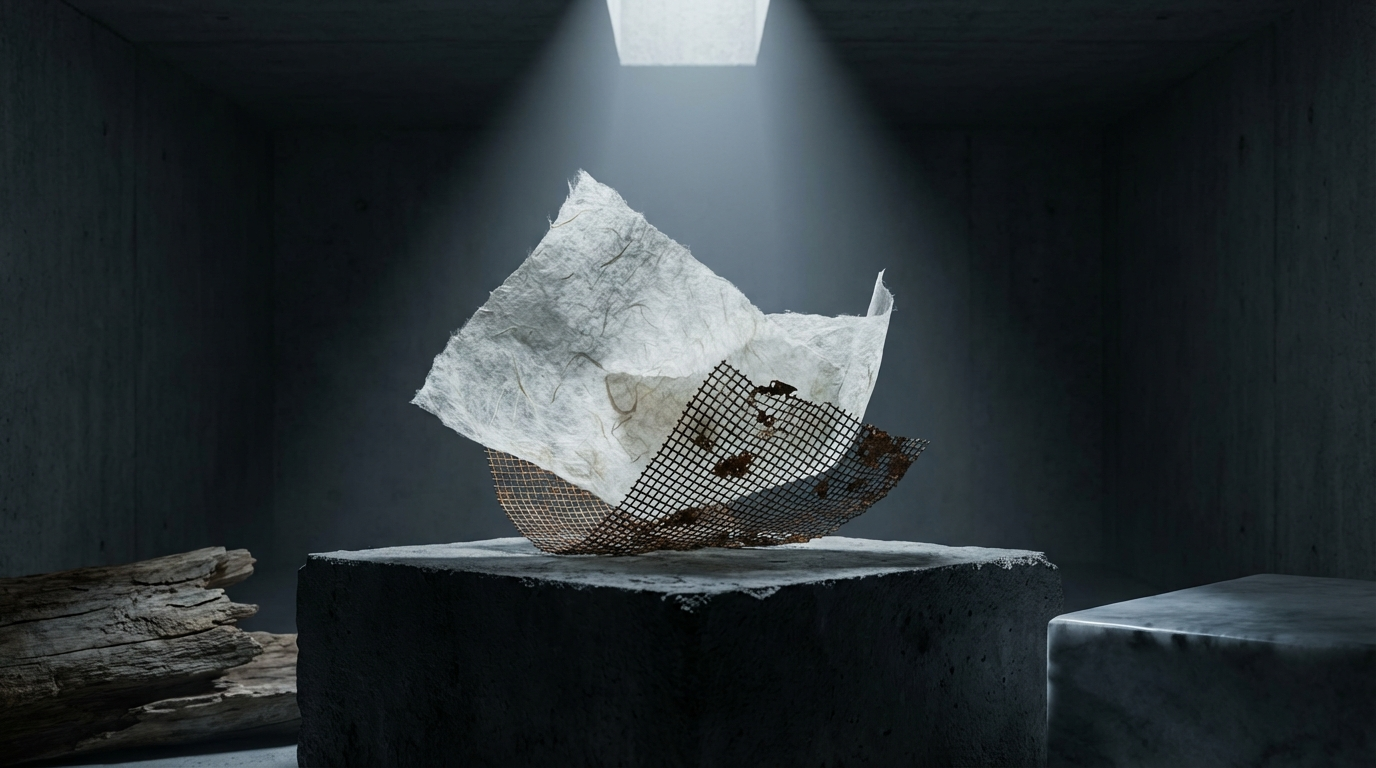
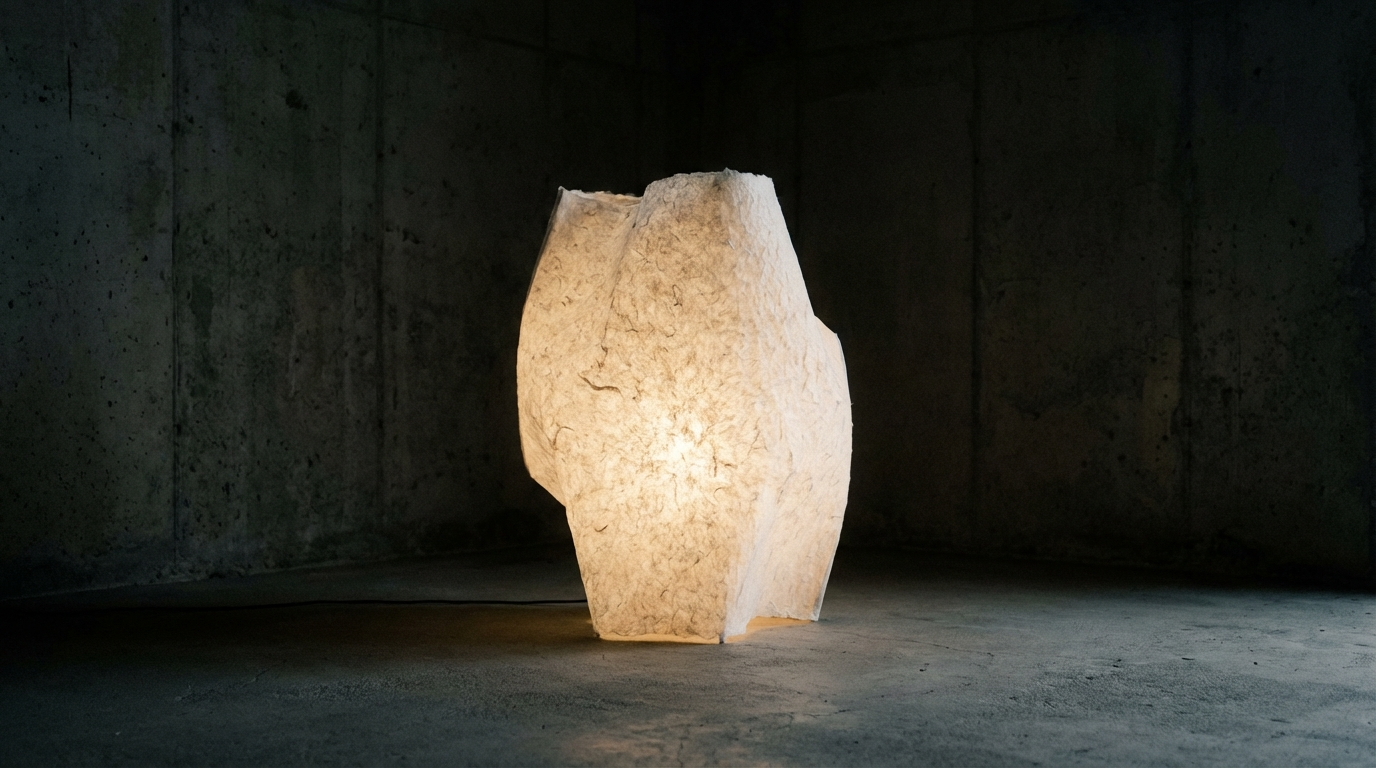
Contemporary design philosophies are increasingly exploiting this organic vitality to challenge the sterile coldness of modern LED lighting and the soulless perfection of industrial, mass-produced interiors. By employing techniques of layering, folding, tearing, and wet-molding Hanji over skeletal armatures of wire, bamboo, or bent wood, modern creators construct volumetric forms that seem to levitate in the darkness. These are not merely lamps; they are luminous sculptures, capturing the essence of air and light in a tangible net. When illuminated from within, the paper undergoes a breathtaking metamorphosis. The light reveals the paper’s chaotic, microscopic architecture—a sprawling, nebula-like constellation of tangled mulberry fibers, raw nodes, and subtle imperfections trapped in a milky, translucent suspension. The light is not simply transmitted through the surface; it is caught, refracted, scattered, and fundamentally warmed by the organic matter.
The resulting illumination is deeply, almost viscerally comforting. It possesses a heavy, tactile quality that mechanical diffusers, frosted glass, or synthetic plastics can never hope to replicate. It is a light that has been filtered through the memory of the forest. In this interplay of illumination and fiber, we witness a masterclass in the aesthetics of shadows. The dense clusters of mulberry create subtle, shifting topographies of light and dark across the surface of the sculpture, bringing an element of the sublime into the domestic sphere. This celebration of organic irregularity aligns seamlessly with the principles of wabi-sabi—the Japanese aesthetic philosophy that finds perfection in the imperfect, the incomplete, and the rustic. The raw, unbleached texture of Hanji, with its occasional flecks of dark bark and uneven thickness, stands as a testament to the beauty of the unrefined. It is luxury derived not from flawless execution, but from the profound character of the natural world.
Furthermore, the most compelling aspect of this medium—and the reason it resonates so deeply within the highest echelons of modern craft—is its inherent fragility and its inevitable trajectory toward decay. We exist in a hyper-industrialized, technologically saturated society that is pathologically obsessed with permanence, sterilization, and indestructible synthetic polymers. In such a milieu, a luxury object crafted from paper is a radical, subversive statement of vulnerability. It demands a relationship with its owner. It requires care, mindfulness, and a gentle touch. Over the decades, it will not remain pristine; it will slowly oxidize, its pale surface curing into a rich, golden patina. It may warp slightly, and it may eventually tear. This impermanence, echoing the Buddhist concept of mono no aware—the bittersweet awareness of the transience of things—is not a flaw to be engineered out, but the very soul of the object.
To embrace Hanji is to embrace the ephemeral nature of our own existence. It reminds the observer that true beauty is intrinsically, inextricably linked to fragility. A flower is beautiful precisely because it will wilt; a Hanji sculpture is profoundly moving precisely because it will not outlast the earth from which it was born. In an age of relentless speed and artificial permanence, these breathing, luminous membranes stand as a quiet rebellion. They invite us to pause, to lower our voices, to appreciate the delicate, unrepeatable texture of the present moment, and to find enduring warmth in the fleeting and the ephemeral. They are not just objects of design; they are philosophical anchors, tethering us to the ancient, rhythmic breath of the natural world.