Time as a Material: The Purification of Ottchil
23 March 2026
Ottchil transforms toxic tree sap into an immortal surface through a grueling, alchemical process of layering and curing. This ancient craft redefines luxury as the ultimate accumulation of time, demanding absolute surrender to nature's rhythms.
When we look at a finished piece of Ottchil—traditional Korean lacquerware—we see a surface of absolute, impenetrable smoothness. It is a finish so deep, so lustrous and unyielding, that it seems to pull the viewer’s gaze into a silent, bottomless pool. Yet, this flawless exterior is profoundly deceptive, masking a brutal and beautiful genesis. It is not the result of a single, uniform application, nor is it a simple coating meant to merely protect the wood beneath. In the realm of high-end craft, Ottchil represents the ultimate paradigm of brutalist luxury—a refined elegance born from unforgiving elements and ascetic discipline. It is the physical accumulation of time. It is a material that demands to be understood not as a paint or a mere finish, but as a living, breathing entity that undergoes a rigorous cycle of suffering, purification, and eventual transcendence. To touch Ottchil is to touch crystallized time.
The journey of this extraordinary medium begins deep within the primordial quiet of the forest, with the careful tapping of the Rhus verniciflua, the native lacquer tree. The raw sap collected from these deliberate wounds is a toxic, milky-white substance laden with urushiol—a potent compound that causes severe, blistering allergic reactions upon contact with human skin. This is raw, unrefined nature in its most defensive, hostile state. It is the tree’s blood, its venom, its immune response to injury. In this toxic sap, we find the first philosophical tenet of Ottchil: the profound duality of Yin and Yang. That which can harm possesses the latent power to heal, protect, and preserve. To transform this volatile, dangerous sap into a medium of transcendent art requires an alchemical and grueling process of purification.
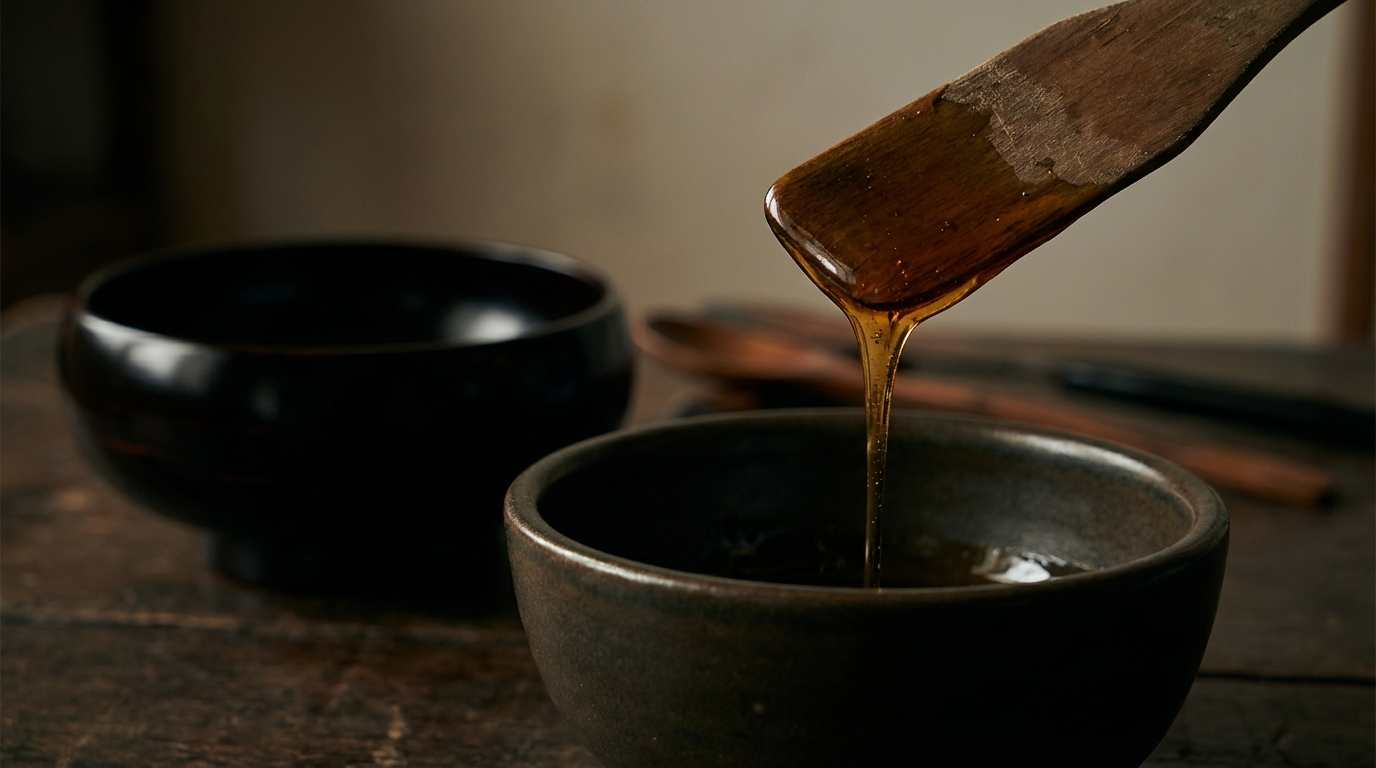
The collected sap is brought into the sanctuary of the studio, where it is slowly stirred over a gentle, constant heat for days on end. This is not a mechanical process, but a rhythmic, meditative dialogue between the artisan and the material. As it is stirred, the excess moisture within the sap begins to evaporate. The artisan watches as the material cooks, its color deepening and shifting from a cloudy, milky white to a rich, translucent amber. Impurities are painstakingly filtered out through layers of hemp cloth. This refined sap, now stripped of its excess water but retaining its volatile essence, is finally ready to begin its long, collaborative dialogue with human hands.
But before the lacquer can even grace the final surface, the foundation must be prepared, a process that speaks deeply to the philosophy of impermanence. Wood, the traditional substrate for Ottchil, is a living material that expands, contracts, and eventually decays. To arrest this inevitable march of time, the artisan must bind the wood. Often, the surface is tightly wrapped in fine hemp cloth, which is adhered using a mixture of raw lacquer and earthen powders, such as bone dust or finely ground clay. This foundational layer is a testament to the unseen structural integrity of true luxury. The hemp and earth create an unbreakable matrix, a brutalist skeleton that subjugates the wood's desire to warp, forcing it into a state of eternal stillness.
The true, staggering weight of Ottchil, however, is felt in its application. A single wooden object may require anywhere from twenty to forty distinct, microscopic layers of lacquer. The artisan applies a razor-thin film of the refined sap, then places the object in a 'chiljang'—a specialized wooden curing cabinet that maintains a precise, unwavering balance of high heat and high humidity. Herein lies one of the most beautiful paradoxes of the craft: lacquer does not dry in the open air; it only cures, or hardens, by drawing moisture from a humid environment. The lacquer drinks the water from the air to close its polymer chains, transforming from a liquid into an impenetrable solid. This is Yin and Yang materialized once more—the wetness of the air is required to create the ultimate dryness of the surface. This agonizingly slow curing process can take days, sometimes weeks, for a single layer.
Once hardened, the surface is mercilessly sanded down. This is the violent heartbeat of Ottchil. The artisan uses increasingly fine grit, often relying on natural abrasives like dried lotus leaves, ginkgo leaves, or specialized charcoal, to grind the cured lacquer until it is entirely flat and matte. It seems counterintuitive to destroy the very surface that took days to build, but this is the essence of brutalist luxury and the wabi-sabi philosophy: strength is forged through reduction. The artisan strips away the ego of the material, leaving only the essential, microscopic foundation. Any imperfection, any trapped speck of dust, must be eradicated.
Then, the next layer is applied. Coat, cure, sand. Coat, cure, sand. This rhythmic, almost monastic repetition is the soul of the practice. The artisan is not just building up a physical surface; they are literally building up time. The finished object carries within it the invisible strata of the artisan's labor, the weeks, months, and sometimes years spent waiting for the sap to harden in the dark humidity of the chiljang. It is a silent communion between human hands, atmospheric moisture, and tree resin. In an era obsessed with instantaneity, mass production, and fleeting trends, Ottchil stands as a monolithic defiance. It is a testament to the belief that true value cannot be rushed, synthesized, or faked.
As the final layers are applied, the sanding becomes impossibly fine. The charcoal gives way to the softest powders, and finally, to the friction of the artisan’s own bare hands, rubbed with vegetable oils to bring out a luster that comes from deep within the material, rather than sitting on top of it. The toxic venom of the forest has been entirely transmuted into a surface that is food-safe, hypoallergenic, and impervious to water, heat, acid, and rot. Items coated in Ottchil have been pulled from ancient shipwrecks thousands of years old, their surfaces as perfect as the day they were submerged.
Ultimately, Ottchil is revered not just for its unparalleled, almost supernatural durability, but because it embodies a profound cultural and material philosophy. It teaches us that true resilience, unfathomable depth, and transcendent beauty can only be achieved through repeated cycles of trial, refinement, and time. The finished object is no longer just wood and tree sap; it is a philosophical monument. It holds the shadows of the forest, the heat of the fire, the moisture of the air, and the lifespan of the artisan. When we gaze into the dark, flawless mirror of an Ottchil vessel, we are not looking at a reflection of the world as it is, but a reflection of what it takes to achieve perfection: an absolute, unwavering surrender to the slow, punishing, and beautiful passage of time.